If you’re enthusiastic to capture the beauty of the night sky, choosing the right camera is essential. With so many options available, it can feel overwhelming. Certain models are designed specifically for beginners, offering ease of use and impressive image quality. In this guide, we’ll explore the top 10 cameras that can help you start your astrophotography journey. By the end, you’ll have a clearer idea of what suits your needs best.
SVBONY SV105 Telescope Camera for Astrophotography Beginners
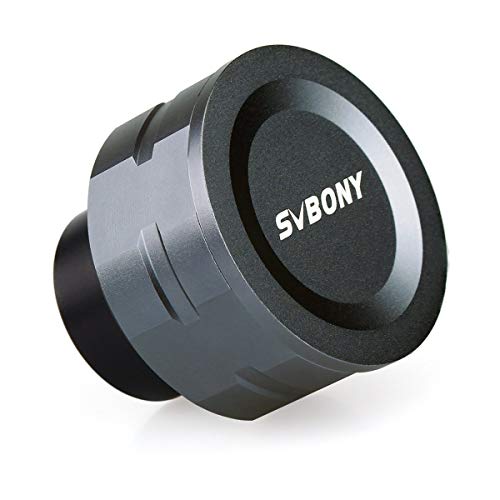
The SVBONY SV105 Telescope Camera is perfect for budding astrophotographers who want to capture stunning images of the moon and planets with ease. Its 1.25″ USB3.0 IMX307 CMOS color sensor delivers 1920×1080 resolution at 30 frames per second, ensuring you won’t miss any details. You can enjoy real-time views on your laptop or PC without needing to install drivers, making it incredibly user-friendly. Compatible with Windows, Linux, and macOS, the SV105 also features dark light compensation to enhance your low-light photography. With its standard design, it’s ideal for bright planets, the moon, and even terrestrial targets. Get ready to explore!
Best For: Beginners in astrophotography looking to capture high-quality images of the moon and planets with ease.
Pros:
- Easy plug-and-play operation with no driver installation required.
- High-resolution imaging at 1920×1080 with 30 frames per second for dynamic observation.
- Compatible with various operating systems including Windows, Linux, and macOS.
Cons:
- Not compatible with Apple phones or tablets (iOS systems).
- Limited to capturing bright celestial objects and terrestrial targets, may not perform as well in other scenarios.
- Some users may require additional software for optimal use, depending on their operating system.
SVBONY SV905C Guide Camera for Astrophotography

For those just starting in astrophotography, the SVBONY SV905C Guide Camera stands out with its impressive 1.23-megapixel resolution and high peak quantum efficiency of 80%. This compact camera features a 1/3” CMOS sensor with small 3.75-micron pixels, ensuring tight tracking of faint guide stars thanks to its low read noise. With a USB 2.0 interface and compatibility with popular software like PHD2 and NINA, you’ll streamline your guiding process. The adaptable design fits various guide lenses, making it easy to focus and position. Whether for autoguiding or planetary imaging, the SV905C enhances your astrophotography experience.
Best For: Beginners and enthusiasts in astrophotography seeking a compact and efficient guiding camera for autoguiding and planetary imaging.
Pros:
- High peak quantum efficiency (QE) of 80% allows for excellent sensitivity in capturing faint guide stars.
- Compact design with adaptable features makes it easy to use with various guide lenses.
- Compatible with popular astrophotography software, streamlining the guiding process.
Cons:
- Limited to a resolution of 1.23 megapixels, which may not satisfy advanced astrophotographers looking for higher resolution.
- USB 2.0 interface may be slower compared to newer USB standards, potentially affecting data transfer speeds.
- Requires additional adapters for certain lens types, which may complicate setup for some users.
Smart Telescope with 4K Astrophotography Camera
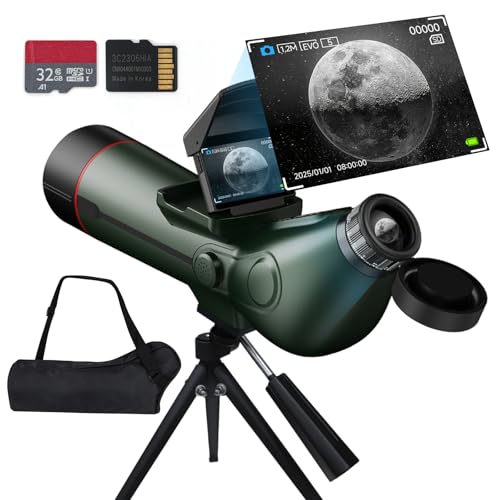
Offering crystal-clear views and stunning 4K high-resolution images, this smart telescope with a 4K astrophotography camera is perfect for beginners keen to explore the night sky. With an 80mm aperture and 300mm focal length, you’ll enjoy bright, detailed views, even in low light. The dual-screen display features an adjustable eyepiece and a foldable external screen for vivid observation. Capture your celestial adventures with a one-touch switch for photos and videos, supporting up to 512GB of storage. Plus, the built-in 4500mAh battery guarantees up to six hours of use, making it an ideal companion for stargazing or nature watching.
Best For: This smart telescope is best for beginners and astronomy enthusiasts eager to explore the night sky with ease and clarity.
Pros:
- User-friendly design with a one-touch switch for easy photo and video capture.
- High-capacity battery providing up to 6 hours of operation for extended stargazing sessions.
- Versatile use as a spotting scope, making it suitable for a variety of outdoor activities.
Cons:
- Limited to 350X magnification, which may not satisfy advanced users seeking higher magnification.
- Requires external storage for saving images and videos, which is not included.
- May be less effective in extremely bright daylight despite the built-in sunshade.
SVBONY SV205 Astrophotography Camera

Designed with beginners in mind, the SVBONY SV205 Astrophotography Camera features a user-friendly plug-and-play setup that requires no driver installation. With a 7.05MP IMX415 imaging sensor, it captures stunning images and videos, even in low light, thanks to its dark light compensation technology. You can record in MJPG format at 30FPS or opt for 15FPS at 3264×2160 resolution. Connecting via USB 3.0 allows you to share real-time views of the night sky with your laptop or PC. Included accessories like a dust cover and cleaning cloth make it easy to maintain, ensuring you’re always ready for your next astrophotography adventure.
Best For: Beginners in astrophotography looking for an easy-to-use camera with plug-and-play functionality.
Pros:
- Easy installation with no driver needed for setup.
- High-quality imaging with 7.05MP sensor and dark light compensation for low-light clarity.
- USB 3.0 connectivity allows for real-time sharing of images and videos on a laptop or PC.
Cons:
- Limited to MJPG video format, which may not be suitable for all users.
- Frame rate drops to 15FPS at higher resolution, which may affect video smoothness.
- Primarily designed for beginners; more advanced users might find it lacking in features.
SVBONY SV305C Astrophotography Camera

The SVBONY SV305C Astrophotography Camera stands out as an excellent choice for beginners enthusiastic to plunge into planetary and lunar photography. This 2.1MP color camera features the advanced IMX662 sensor and boasts low readout noise, enhancing light sensitivity. You’ll find it ideal for EAA with its high-speed planetary mode and long exposure options in SharpCap software. The built-in image buffer prevents interruptions, while the ROI function lets you customize resolution to increase capture rates. Plus, its HCG noise reduction technology automatically activates to reduce noise when needed, ensuring you get clear, stunning images of the night sky.
Best For: Beginners looking to explore planetary and lunar photography with an easy-to-use astrophotography camera.
Pros:
- High light sensitivity and low readout noise for clearer images, especially in the red spectral band.
- Offers both high-speed and long exposure photography modes, making it versatile for different astrophotography needs.
- Built-in image buffer and ROI function enhance image capture rates and reliability during USB interruptions.
Cons:
- Limited to 2.1MP resolution, which may not satisfy advanced astrophotographers seeking higher image quality.
- Non-removable UV/IR CUT filter might restrict some imaging preferences.
- Compatibility primarily with 1.25-inch interfaces may limit options for users with different telescope setups.
4K Telescope Camera for Astrophotography

A standout feature of the K Telescope Camera is its advanced low-light compensation technology, making it an excellent choice for beginners in astrophotography. With 4K video recording and an 8MP CMOS sensor, you’ll capture stunning images up to 64MP. The 2.8-inch IPS mini screen offers real-time electronic imaging and high color accuracy, enhancing your viewing experience. Plus, you can connect two devices via WiFi for remote viewing. Its universal locking groove fits various eyepieces, ensuring compatibility with telescopes and microscopes. With a built-in battery and support for microSD cards, you’re set for extended adventures capturing the night sky.
Best For: Beginners in astrophotography and outdoor enthusiasts looking for an easy-to-use camera with advanced features.
Pros:
- High-quality imaging with 4K video recording and up to 64MP image capture.
- User-friendly design with a compact 2.8-inch IPS mini screen for real-time viewing.
- Versatile compatibility with various optical devices, including telescopes and microscopes.
Cons:
- Limited WiFi range (32ft) may restrict remote viewing in larger outdoor setups.
- Battery life may be a concern during extended night-time use without charging options.
- Learning curve for app functionalities might be challenging for complete beginners.
4K Wireless Telescope Camera with X16 Zoom & 2.8″ Screen

For budding astrophotographers seeking an accessible entry into celestial imaging, the K Wireless Telescope Camera with X16 Zoom and 2.8″ screen stands out with its impressive 4K video recording and 8MP high-resolution imaging capabilities. You’ll appreciate the 64MP image capture and advanced low-light compensation for sharp visuals, even in dim conditions. The upgraded IPS mini screen offers excellent color accuracy, while WiFi connectivity lets you connect two devices for remote viewing. With a universal locking groove and compatibility with various optical devices, plus a 2000mAh battery and microSD support, this camera is perfect for capturing and sharing your adventures.
Best For: Budding astrophotographers and outdoor enthusiasts looking for an accessible and versatile camera for capturing high-quality images and videos of celestial bodies and wildlife.
Pros:
- High-resolution 4K video recording and 64MP image capture with low-light compensation for clear visuals.
- WiFi connectivity allows for remote viewing and simultaneous connection for two devices.
- Universal compatibility with various optical devices, enhancing versatility for different observational needs.
Cons:
- Limited screen size (2.8 inches) may hinder detailed viewing during some activities.
- The battery life may not be sufficient for extended outdoor sessions without recharging.
- Reliance on microSD cards for storage could be inconvenient if not readily available.
Celestron NexImage 5 Solar System Imager

Designed specifically for lunar and planetary astrophotography, the Celestron NexImage 5 Solar System Imager is an excellent choice for beginners enthusiastic to capture stunning celestial images. With its 5MP CMOS sensor, you’ll enjoy high-resolution color imaging without any fuss. The plug-and-play setup makes it easy to capture your first astrophotography images in just minutes—no prior experience needed! It connects effortlessly to Windows computers via USB, and fits any 1.25-inch focuser. Plus, the included camera control software allows live video and image adjustments, ensuring you reveal fine surface details of the Moon and planets. You’ll love the results!
Best For: Beginners interested in capturing high-resolution lunar and planetary images with minimal setup and experience.
Pros:
- Easy plug-and-play setup allows for quick and straightforward use.
- High-resolution color imaging reveals fine details on celestial bodies.
- Included camera control software supports live video and image adjustments.
Cons:
- Limited compatibility as it only connects to Windows computers.
- Requires a 1.25-inch focuser, which may not fit all telescopes.
- No external power option, relying solely on USB power.
8K Digital Camera with 88MP and 16X Zoom
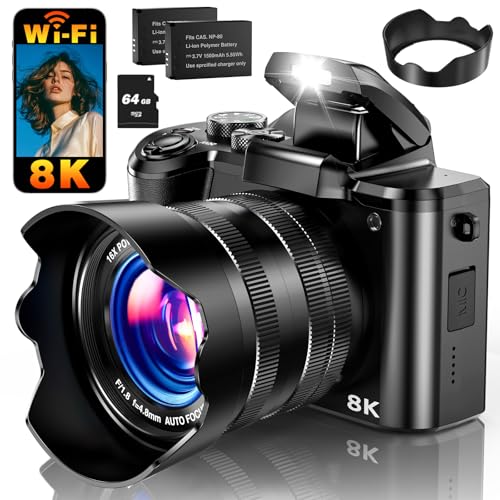
Capturing the wonders of the night sky is made easier with the K Digital Camera, boasting an impressive 88MP resolution and a powerful 16X zoom lens. This camera features quick autofocus and built-in anti-shake technology, ensuring clear images even in low light. The dual-lens setup and 3.2-inch HD touchscreen make framing your shots a breeze. Plus, with built-in Wi-Fi, sharing your astrophotography is effortless. It comes with essential accessories, including a 64GB card and two rechargeable batteries, perfect for extended stargazing sessions. Compact and backed by 24/7 customer support, it’s an ideal choice for budding astrophotographers.
Best For: Budding astrophotographers and beginners looking for a versatile, easy-to-use camera for capturing high-quality images and videos.
Pros:
- Exceptional 88MP resolution and 16X zoom for detailed astrophotography.
- Quick autofocus and built-in anti-shake technology for clearer images in low light.
- Compact design with essential accessories included, making it travel-friendly.
Cons:
- Limited advanced features for professional photographers.
- Battery life may vary depending on usage during extended shooting sessions.
- Built-in flash may not be sufficient for very low-light conditions.
SVBONY SV305C Pro Telescope Camera for Astrophotography

The SVBONY SV305C Pro Telescope Camera stands out as an excellent choice for beginners in astrophotography, thanks to its impressive 2MP IMX662 sensor. With ultra-high sensitivity and low noise, you’ll capture stunning planetary details even in low light. The camera delivers 1920×1080 resolution at 107FPS, perfect for fast-moving planets like Jupiter and Saturn. Its USB 3.0 connection guarantees rapid data transfer, and the 128MB DDR buffer prevents image loss during continuous capture. Plus, with simplified setup and Any Area ROI support, you can easily focus on specific celestial regions, making your astrophotography experience smooth and enjoyable.
Best For: The SVBONY SV305C Pro Telescope Camera is best for beginners in astrophotography seeking an accessible and high-performance camera for capturing detailed images of celestial bodies.
Pros:
- Ultra-high sensitivity and low noise for clear imaging in low light conditions.
- High-speed USB 3.0 connection ensures rapid data transfer, enhancing the user experience.
- Simplified setup and Any Area ROI support make it easy to focus on specific celestial regions.
Cons:
- Limited to planetary imaging, which may not suit those interested in deep-sky astrophotography.
- Requires a computer for operation, which may not be ideal for all users.
- Performance may vary based on atmospheric conditions, potentially affecting image quality.
Factors to Consider When Choosing a Camera for Astrophotography Beginners
When choosing a camera for astrophotography, you’ll want to contemplate several key factors. Sensor quality is essential for capturing those stunning night sky details, while compatibility with software can streamline your editing process. Don’t forget to reflect on ease of use and your budget, as they’ll play a big role in your overall experience.
Sensor Quality Importance
Understanding sensor quality is vital for achieving stunning astrophotography results. The quality of your camera’s sensor considerably affects image clarity and detail. Higher resolution sensors capture finer features of celestial objects, making them essential for your night sky images. Look for sensors with larger pixel sizes, like 2.9µm or greater, which gather more light and perform better in low-light conditions. Back-illuminated sensors, such as the IMX662, enhance sensitivity, improving image quality during long exposures. Pay attention to the peak quantum efficiency (QE); higher QE percentages convert light into electrical signals more effectively, capturing faint stars. Additionally, features like low read noise and high dynamic range (HDR) guarantee clearer images across varying light intensities, allowing you to capture both bright and dim celestial bodies beautifully.
Compatibility With Software
Choosing the right camera for astrophotography goes beyond just sensor quality; software compatibility is also key to enhancing your photographic experience. Make certain your camera works with popular software like Sharpcap, PHD2, or NINA, as these tools greatly improve image capture and processing. Check for support across multiple operating systems, like Windows, Linux, and macOS, confirming you can use it with various devices. USB interfaces are essential for smooth connectivity and real-time data transfer, so verify your camera has this feature. Look for specific guiding interfaces, like ST4, for precise tracking of celestial objects. Finally, verify the camera’s software allows live video, frame stacking, and manual adjustments to capture stunning astrophotographs.
Ease of Use
As you immerse yourself in astrophotography, selecting a camera that’s easy to use can make all the difference in your experience. Look for cameras that operate on a plug-and-play basis, so you won’t need to fuss with driver installations. Real-time dynamic observation features are a must, letting you view and capture images instantly on your device. Verify the camera’s software is user-friendly and compatible with popular capture programs to streamline your imaging process. Accessories like user manuals and cables included with the camera can greatly enhance your experience and ease initial setup challenges. Finally, choose models with standard interfaces that fit common telescope configurations, guaranteeing compatibility and straightforward use right from the start.
Image Processing Features
After getting comfortable with a user-friendly camera, you’ll want to focus on its image processing features to elevate your astrophotography experience. Look for cameras that offer built-in functions like Region of Interest (ROI), which let you select specific areas of the image for better capture rates without sacrificing resolution. High dynamic range (HDR) capabilities are also vital, as they provide vibrant images with reduced chromatic aberration. A built-in image buffer, like a 128MB DDR buffer, is essential for continuous capture, preventing image loss during fast celestial events. Additionally, features such as binning improve sensitivity in low-light conditions, while low readout noise technology guarantees sharper images by minimizing unwanted noise. These features will greatly enhance your astrophotography journey.
Budget Considerations
Establishing a budget before diving into astrophotography can save you time and frustration when selecting the right camera. Prices vary widely, with entry-level models around $100 to $300 and advanced options exceeding $500 or even $1000. It’s essential to take into account not just the camera’s purchase price but also the additional costs associated with lenses, filters, and software, which can greatly add to your investment. Aim for cameras that provide a balance of features and performance for your budget, ensuring they meet your astrophotography needs without breaking the bank. Take the time to research user reviews and expert recommendations to find quality options that won’t compromise your wallet, setting you up for successful stargazing photography.