When it comes to photography, having the right HDR monitor can greatly enhance your editing experience. You need a display that showcases your images with accurate colors and stunning clarity. From advanced panel technologies to impressive resolution, the right monitor can make all the difference in your workflow. But with so many options available, how do you choose the best one for your needs? Let’s explore the top contenders that can elevate your work.
BenQ SW272Q 27-inch 2K Photographer Monitor

If you’re a photographer seeking unparalleled color accuracy and vibrant detail, the BenQ SW272Q 27-inch 2K Photographer Monitor is an ideal choice. With a stunning 2K QHD resolution and 99% Adobe RGB coverage, it presents a breathtaking palette of colors. The Nano Matte Panel minimizes glare, ensuring your creative process remains uninterrupted. Plus, BenQ’s Paper Color Sync technology guarantees consistency between your screen and prints. Experience hardware calibration that’s 40% faster, enhancing your workflow. Designed for comfort and inspiration, this monitor transforms your workspace into a creative haven, empowering you to produce high-quality professional deliverables that resonate with emotion.
Best For: Photographers and creative professionals seeking exceptional color accuracy and detail in their digital work.
Pros:
- Exceptional 99% Adobe RGB and 98% DCI-P3 color coverage for vibrant, true-to-life visuals.
- Fast hardware calibration with Palette Master Ultimate software enhances workflow efficiency.
- Nano Matte Panel minimizes glare, providing a comfortable viewing experience for long editing sessions.
Cons:
- The 27-inch size may be limiting for some users who prefer larger screens for multitasking.
- Higher price point compared to standard monitors, which may not fit all budgets.
- Limited HDR capability may not satisfy users looking for advanced HDR performance.
LG 27US500-W Ultrafine 27-Inch 4K UHD Monitor
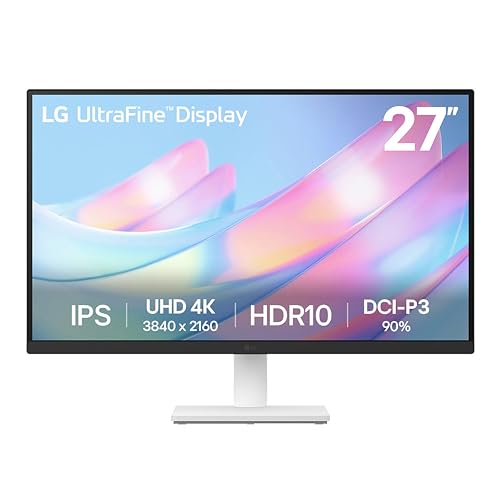
The LG 27US500-W Ultrafine 27-Inch 4K UHD Monitor stands out for its impressive 4K resolution and HDR10 support, making it a top choice for creative professionals who demand exceptional color accuracy and detail in their photography work. With a 1000:1 contrast ratio, you’ll experience deeper blacks and vibrant colors, ensuring your images pop. The monitor’s borderless design enhances its aesthetic, while the ergonomic stand lets you adjust the tilt for ideal viewing. Plus, the Onscreen Control feature allows for easy customization of your workspace. With included accessories like an HDMI cable, you’re ready to elevate your editing experience right away.
Best For: Creative professionals seeking high-resolution displays for detailed digital imagery and exceptional color accuracy.
Pros:
- Supports 4K UHD resolution for stunning image clarity and detail.
- HDR10 compatibility enhances color vibrancy and contrast for a more immersive viewing experience.
- Ergonomic stand allows for flexible tilt adjustments, promoting comfortable long-term use.
Cons:
- May be considered expensive compared to standard monitors with lower resolution.
- Limited connectivity options could restrict compatibility with some devices.
- Some users may find the borderless design less durable over time.
ASUS ProArt Display PA278QV 27” WQHD Monitor

For photographers seeking exceptional color accuracy, the ASUS ProArt Display PA278QV 27” WQHD monitor stands out as an excellent choice. With a resolution of 2560 x 1440, it offers stunning visuals on its frameless design. You’ll appreciate the 100% sRGB and 100% Rec. 709 color gamut, and the factory-calibrated Delta E < 2 guarantees precise colors. The IPS panel provides excellent viewing angles and an anti-glare feature for comfortable editing. Plus, it comes with extensive connectivity options, including Mini DisplayPort and USB 3.0 ports. Don’t forget the 3-month complimentary access to Adobe Creative Cloud, adding even more value.
Best For: Photographers and creative professionals seeking exceptional color accuracy and extensive connectivity options for their editing needs.
Pros:
- Excellent color accuracy with 100% sRGB and 100% Rec. 709 coverage.
- Factory calibrated for Delta E < 2, ensuring precise color reproduction.
- Extensive connectivity options including Mini DisplayPort, HDMI, and USB 3.0 ports.
Cons:
- The 27” size may be too large for some desktop setups.
- Limited to a maximum resolution of 2560 x 1440, which may not satisfy users seeking 4K quality.
- The anti-glare feature may not be sufficient in very bright environments.
ASUS ProArt Display PA279CV 27” 4K HDR UHD Monitor

Photographers seeking exceptional color accuracy will find the ASUS ProArt Display PA279CV 27” 4K HDR UHD monitor an ideal choice. With a stunning 3840 x 2160 resolution and an IPS panel, it delivers vibrant visuals and precise details. You’ll appreciate its 100% sRGB and Rec. 709 wide color gamut, ensuring your images look true to life. Factory calibration guarantees a Delta E < 2 for remarkable accuracy. Plus, its extensive connectivity options, including DisplayPort over USB-C and HDMI, make it compatible with various devices. As a bonus, you’ll get three months of complimentary access to Adobe Creative Cloud.
Best For: Photographers and creative professionals seeking exceptional color accuracy and vibrant visuals in a 4K monitor.
Pros:
- 100% sRGB and Rec. 709 wide color gamut ensures true-to-life color representation.
- Factory calibrated with Delta E < 2 for remarkable color accuracy straight out of the box.
- Extensive connectivity options including DisplayPort over USB-C and HDMI, allowing compatibility with various devices.
Cons:
- Limited gaming features may not satisfy hardcore gamers looking for high refresh rates.
- Price point may be higher compared to standard monitors, making it a more significant investment.
- No built-in speakers could be a drawback for users looking for an all-in-one solution.
ASUS ROG Swift 32” 4K OLED Gaming Monitor (PG32UCDM)

If you’re seeking a top-tier monitor that delivers stunning color accuracy and HDR performance, the ASUS ROG Swift 32” 4K OLED Gaming Monitor (PG32UCDM) is an excellent choice. With a 32-inch QD-OLED display, it offers a resolution of 3840 x 2160, a lightning-fast refresh rate of 240 Hz, and an impressive response time of just 0.03 ms. You’ll appreciate the 99% DCI-P3 color gamut and true 10-bit depth for vibrant visuals. Plus, its advanced cooling system reduces burn-in risks. With a complimentary 3-month Adobe Creative Cloud subscription, you’ll have everything you need to enhance your editing experience.
Best For: Gamers and creative professionals looking for high-performance displays with exceptional color accuracy and refresh rates.
Pros:
- Exceptional color performance with 99% DCI-P3 coverage and true 10-bit depth for vibrant visuals.
- Ultra-fast refresh rate of 240 Hz and a response time of just 0.03 ms for smooth gaming experiences.
- Advanced cooling features including a custom heatsink and graphene film to reduce burn-in risks.
Cons:
- Higher price point may not be suitable for budget-conscious consumers.
- Peak brightness may vary, which could affect HDR performance in certain lighting conditions.
- Limited connectivity options could restrict compatibility with some devices.
ASUS ProArt Display 27” 4K HDR Professional Monitor (PA279CRV)

The ASUS ProArt Display 27” 4K HDR Professional Monitor (PA279CRV) stands out as an exceptional choice for creatives who demand precision in color reproduction. With its 27-inch LED backlight HDR display and UHD resolution of 3840 x 2160, you’ll experience stunning visuals. The IPS panel offers a 178° wide view, while the 99% DCI-P3 and Adobe RGB color gamut guarantees vibrant color accuracy. Factory pre-calibrated to ΔE < 2, you can trust the colors. Plus, extensive connectivity options, ergonomic design, and a 3-year warranty enhance usability. Enjoy three months of complimentary Adobe Creative Cloud access, too!
Best For: Creative professionals and photographers who require exceptional color accuracy and high-resolution displays for their work.
Pros:
- High color accuracy with 99% DCI-P3 and Adobe RGB color gamut, factory pre-calibrated to ΔE < 2.
- Versatile connectivity options including DisplayPort over USB-C with 96W Power Delivery, HDMI, and a USB hub.
- Ergonomic design that promotes comfortable use during long working hours, along with a 3-year warranty for peace of mind.
Cons:
- Higher price point compared to standard monitors, which may not suit budget-conscious buyers.
- Limited built-in speakers, which may be a drawback for users needing audio output without external speakers.
- Weight and size may make it less portable for users who require a monitor for on-the-go use.
Dell 27 Plus 4K Monitor (S2725QS) – 27-inch Display

For those seeking a reliable HDR monitor that excels in color accuracy, the Dell 27 Plus 4K Monitor (S2725QS) stands out with its impressive 99% sRGB color coverage. This 27-inch display boasts a stunning 4K resolution and a 120Hz refresh rate, ensuring vibrant visuals and smooth performance for both work and play. Thanks to its IPS panel technology and 1500:1 contrast ratio, you’ll experience vivid colors and excellent detail. Plus, with AMD FreeSync Premium and ultra-low response time, gaming feels seamless. The minimalist design and integrated speakers further enhance your editing experience, making it a fantastic choice for photographers.
Best For: The Dell 27 Plus 4K Monitor (S2725QS) is best for photographers and gamers seeking exceptional color accuracy and smooth performance in a sleek design.
Pros:
- 99% sRGB color coverage ensures vibrant colors and excellent detail for creative work.
- 120Hz refresh rate and ultra-low 0.03ms response time provide a smooth and responsive gaming experience.
- Integrated speakers with improved sound quality enhance multimedia enjoyment without the need for external audio devices.
Cons:
- HDR performance may not be as robust as higher-end monitors specifically designed for professional HDR content creation.
- Limited adjustability in terms of height and tilt compared to some other monitors in its class.
- Price point may be higher than basic monitors, which could be a consideration for budget-conscious buyers.
BenQ PD3226G 32” 4K UHD Monitor for Designers

Designed specifically for photographers and graphic designers, the BenQ PD3226G 32” 4K UHD Monitor stands out with its impressive 95% P3 and 100% sRGB color coverage. With a stunning 3840×2160 resolution and a 144Hz refresh rate, you’ll enjoy crystal-clear images. Its IPS panel technology guarantees consistent colors from any angle. Reliable color management through BenQ Palette Master Ultimate keeps your work accurate. Plus, the all-in-one Thunderbolt 4 connectivity simplifies connections while delivering power and high data transfer speeds. The built-in KVM switch streamlines workflow, allowing you to control multiple systems effortlessly, all while enjoying eye comfort with its reflection-free panel.
Best For: The BenQ PD3226G 32” 4K UHD Monitor is best for photographers and graphic designers seeking high color accuracy and advanced connectivity options for their creative work.
Pros:
- Exceptional color coverage with 95% P3 and 100% sRGB, ensuring vibrant and accurate visuals.
- All-in-one Thunderbolt 4 connectivity offers high data transfer speeds and power delivery, simplifying setup.
- Built-in KVM switch enhances workflow by allowing control of multiple systems with a single keyboard and mouse.
Cons:
- The high refresh rate of 144Hz may not be fully utilized for design tasks, as it is more beneficial for gaming.
- The large 32” size may not fit in smaller workspaces comfortably.
- Premium features may come at a higher price point compared to standard monitors.
Samsung 27-Inch ViewFinity S7 4K UHD Monitor (LS27D702EANXGO)

Experience stunning visuals with the Samsung 27-Inch ViewFinity S7 4K UHD Monitor, a perfect choice for photographers seeking exceptional color accuracy and contrast. With its 4K UHD resolution, you’ll enjoy increased detail and a higher pixel density that brings your images to life. The HDR10 technology enhances your editing with near-limitless hues, providing true-to-life color representation and deeper contrasts. Connectivity is a breeze with multiple ports, allowing you to connect devices effortlessly. Plus, the easy setup stand and TÜV-certified eye care features guarantee a comfortable editing experience, optimizing brightness and color temperature to protect your eyes during long sessions.
Best For: Photographers and content creators seeking exceptional color accuracy and high-resolution details for their editing needs.
Pros:
- Stunning 4K UHD resolution provides increased detail and higher pixel density for vivid imagery.
- HDR10 technology offers true-to-life color representation and deeper contrast, enhancing editing capabilities.
- TÜV-certified eye care features help reduce eye strain during long editing sessions by optimizing brightness and color temperature.
Cons:
- Limited ergonomic adjustments may not suit all users’ preferences for viewing angles.
- Potentially high price point compared to standard monitors could be a barrier for budget-conscious buyers.
- Availability issues may arise due to demand, making it harder to purchase immediately.
Sceptre 34-Inch Curved Ultrawide WQHD Monitor (C345B-QUT168)

The Sceptre 34-Inch Curved Ultrawide WQHD Monitor (C345B-QUT168) stands out with its impressive 99% sRGB color coverage, making it an excellent choice for photographers who demand accurate color reproduction in their work. With a resolution of 3440 x 1440 and a 21:9 aspect ratio, you’ll enjoy stunning visuals across 5 million pixels. The curved design enhances immersion, offering 30% more screen space than standard monitors. Thanks to a 1ms response time and up to 180Hz refresh rate, ghosting is eliminated, ensuring precise imagery. Plus, built-in speakers and Picture by Picture functionality make multitasking a breeze.
Best For: Photographers and content creators seeking accurate color reproduction and immersive visuals in a wide-screen format.
Pros:
- 99% sRGB color coverage ensures accurate color reproduction for professional work.
- Curved ultrawide design provides enhanced immersion and 30% more screen space compared to conventional monitors.
- Fast refresh rate of up to 180Hz and 1ms response time eliminate ghosting for smooth visuals during fast-paced scenes.
Cons:
- Limited connectivity options with only two DisplayPort inputs.
- Built-in speakers may not provide sufficient audio quality for audiophiles or serious gamers.
- Larger footprint compared to standard monitors, potentially requiring more desk space.
Factors to Consider When Choosing an HDR Monitor for Photography
When you’re choosing an HDR monitor for photography, there are several key factors to keep in mind. You’ll want to take into account resolution and clarity, color accuracy standards, and the type of panel technology. Additionally, think about connectivity options and ergonomic design features to guarantee a comfortable and efficient workflow.
Resolution and Clarity
Choosing the right HDR monitor for photography means considering factors like resolution and clarity, which play vital roles in your editing process. A higher resolution, like 4K UHD (3840 x 2160), offers exceptional detail, allowing you to see fine textures and nuances in your images. While 2K QHD (2560 x 1440) monitors provide sharp visuals, they may lack the depth needed for high-resolution work. Clarity is essential for accurate color and detail representation, and pixel density greatly impacts how sharp images appear. A monitor with a higher pixel density reduces pixelation, enhancing your editing experience. Additionally, HDR capabilities improve clarity by expanding brightness and color ranges, resulting in more lifelike image representation.
Color Accuracy Standards
Accurate color representation is key to achieving stunning photography, and understanding color accuracy standards is vital as you select an HDR monitor. Look for a monitor with a low Delta E value—ideally under 2—for excellent color fidelity. Familiarize yourself with color spaces; sRGB is common for digital images, while Adobe RGB and DCI-P3 offer broader gamuts ideal for print and cinema. Aim for monitors that cover 99% of Adobe RGB and 98% of DCI-P3 for best editing. Hardware calibration support is critical for consistent color reproduction across devices. Additionally, technologies like Calman calibration can enhance accuracy, giving you factory calibration reports that guarantee your monitor meets strict photography standards.
Panel Technology Types
As you explore HDR monitors for photography, understanding the different panel technologies can greatly influence your editing experience. IPS panels excel in color accuracy and offer wide viewing angles, making them perfect for precise color representation. VA panels provide better contrast ratios and deeper blacks, enhancing image depth in low-light situations, although they may lag in response times. OLED technology shines with superior color performance and true blacks, thanks to individual pixel control, resulting in vibrant, HDR-capable images. On the other hand, TN panels, while fast in response time, lack color accuracy and viewing angles, making them less suitable for your photography needs. Choosing the right panel type is essential for achieving ideal results in your editing process.
Connectivity Options Available
When diving into HDR monitors for photography, connectivity options play an essential role in your overall experience. You’ll want to look for monitors that support a variety of connections like HDMI, DisplayPort, and USB-C to guarantee seamless compatibility with your devices. Many professional models come equipped with multiple HDMI ports, DisplayPort, and USB hubs, offering flexible setups for peripherals. If you’re working with high-resolution photography, consider monitors with Thunderbolt 4, which provide high data transfer rates and power delivery. Built-in KVM switches can also be a game-changer, allowing you to control multiple systems with a single keyboard and mouse. Always verify the monitor’s connectivity aligns with your device requirements to avoid compatibility issues and maximize performance.
Ergonomic Design Features
Choosing an HDR monitor for photography goes beyond just picture quality; ergonomic design features are essential for your comfort and productivity. Look for monitors with adjustable stands that let you tilt, swivel, and change height for ideal viewing. A borderless or ultra-thin bezel design not only enhances aesthetics but also creates an immersive workspace, minimizing distractions. To reduce eye strain during extended editing sessions, choose models with flicker-free technology and blue light filters. Additionally, monitors with IPS panels provide wide viewing angles, ensuring consistent color and brightness from different positions. Some even integrate built-in KVM switches, allowing you to control multiple systems with one keyboard and mouse, streamlining your workflow and reducing desk clutter.
Calibration and Software Support
An HDR monitor’s performance hinges not just on its design but also on its calibration and software support. Accurate color representation is vital, so look for monitors with factory calibration that achieves a Delta E of less than 2. This guarantees precise color accuracy essential for your photography. Software like Palette Master Ultimate can help you fine-tune color settings, maintaining screen-to-print consistency. Monitors with hardware calibration capabilities allow you to adjust settings directly on the monitor, simplifying the process. Access to a wide color gamut—like 99% Adobe RGB or 98% DCI-P3—is important for translating your work across different media. Remember, regular calibration is necessary to maintain color fidelity, as monitors can drift over time due to various factors.