When it comes to architectural photography, choosing the right camera can make all the difference in capturing stunning details and designs. You need a camera that not only excels in image quality but also adapts to various lighting conditions and compositions. Whether you’re a beginner or a seasoned pro, the options available cater to different skill levels and needs. Let’s explore the top cameras that can elevate your architectural photography game.
Canon EOS Rebel T7 DSLR Camera with 2 Lens Kit

The Canon EOS Rebel T7 DSLR Camera with 2 Lens Kit is an excellent choice for budding architectural photographers looking to elevate their skills. With its 24.1 Megapixel CMOS sensor, you’ll capture stunning details in every shot. The 9-point AF system and improved Dual Pixel CMOS AF guarantee sharp focus, while eye detection AF helps you frame your subjects perfectly. Plus, you can shoot in FHD 1080p video for dynamic views of architectural masterpieces. With built-in Wi-Fi and NFC, sharing your work is a breeze. Operating comfortably in a range of temperatures, this camera is ready for any architectural adventure you undertake.
Best For: The Canon EOS Rebel T7 DSLR Camera with 2 Lens Kit is best for aspiring architectural photographers seeking high-quality images and video capabilities.
Pros:
- Excellent 24.1 Megapixel CMOS sensor for capturing intricate details.
- Improved autofocus features, including Dual Pixel CMOS AF and eye detection for precise framing.
- Built-in Wi-Fi and NFC for easy sharing of photos and videos.
Cons:
- Limited to FHD 1080p video resolution, which may not satisfy those needing 4K capabilities.
- Optical viewfinder offers only 95% coverage, which may lead to missed framing in some situations.
- The ISO range, while decent, may not perform as well in very low-light conditions compared to higher-end models.
Canon EOS Rebel T7 DSLR Camera Kit

For budding photographers and architecture enthusiasts, the Canon EOS Rebel T7 DSLR Camera Kit offers an impressive blend of features that make capturing stunning architectural images a breeze. With a 24.1MP APS-C CMOS sensor and DIGIC 4+ image processor, you’ll enjoy vibrant colors and sharp details, even in low light. The built-in Wi-Fi and NFC allow for seamless photo sharing, while the lightweight design and comfortable grip make it perfect for long shooting sessions. Plus, the kit includes an 18-55mm lens and a 64GB memory card, providing everything you need to start your architectural photography journey right away.
Best For: Budding photographers and architecture enthusiasts looking for a user-friendly DSLR camera with impressive image quality and connectivity features.
Pros:
- Exceptional image quality with vibrant colors and sharp details thanks to the 24.1MP sensor and DIGIC 4+ processor.
- Built-in Wi-Fi and NFC facilitate easy photo sharing and remote shooting with the Canon Camera Connect app.
- Lightweight design and comfortable grip make it ideal for extended photography sessions.
Cons:
- Limited maximum shutter speed of 1/4000 seconds may not be sufficient for fast-moving subjects.
- The ISO range, while expandable, may not perform as well in extremely low light situations compared to higher-end models.
- The included 18-55mm lens may not satisfy advanced photographers looking for specialized lens options.
Canon EOS R50 Mirrorless Camera with RF-S18-45mm Lens Kit

When capturing stunning architectural shots, the Canon EOS R50 Mirrorless Camera with the RF-S18-45mm Lens Kit stands out with its impressive 24.2 Megapixel CMOS sensor. You’ll appreciate the high image clarity and exceptional low-light performance, thanks to the DIGIC X processor. With high-speed continuous shooting up to 15 fps, you won’t miss a detail. The advanced Dual Pixel CMOS AF II guarantees precise focusing with 651 AF zones, making tracking subjects effortless. Plus, the vari-angle touchscreen and built-in Bluetooth and Wi-Fi enhance usability, letting you transfer files easily. This camera is perfect for documenting architecture in all its glory.
Best For: The Canon EOS R50 Mirrorless Camera is best for photographers seeking a versatile and high-performance camera for capturing stunning architectural shots and fast-moving subjects.
Pros:
- High image clarity with a 24.2 Megapixel sensor and DIGIC X processor for excellent image quality.
- Advanced autofocus with 651 AF zones and deep learning technology for accurate subject tracking.
- Versatile shooting options with a vari-angle touchscreen and built-in Bluetooth and Wi-Fi for easy file transfer.
Cons:
- Limited low-light performance at higher ISO settings compared to full-frame cameras.
- The lens kit may not include a wider-angle option for expansive architectural shots.
- Continuous shooting speed may decrease when using certain autofocus settings.
Canon EOS R6 Mark II Mirrorless Camera (Body Only)

With its impressive 24.2 Megapixel full-frame sensor and advanced autofocus capabilities, the Canon EOS R6 Mark II Mirrorless Camera (Body Only) stands out as an excellent choice for architectural photographers. You’ll appreciate its ability to capture every detail, thanks to the DIGIC X Image Processor and high-speed continuous shooting at 40 fps. The Dual Pixel CMOS AF guarantees precise focus on architectural elements, while the 3.0-inch vari-angle touchscreen allows for creative compositions. Plus, with a robust ISO range and optimized video recording, this camera offers versatility, making it perfect for both stills and dynamic scenes.
Best For: The Canon EOS R6 Mark II Mirrorless Camera is best for professional photographers and videographers seeking high-quality imaging and advanced autofocus capabilities for a variety of shooting scenarios.
Pros:
- Exceptional Image Quality: 24.2 Megapixel full-frame sensor captures stunning detail and dynamic range.
- Fast Autofocus: Dual Pixel CMOS AF with advanced subject tracking ensures precise focus on moving subjects.
- Versatile Connectivity: Built-in Wi-Fi and Bluetooth, alongside USB Type-C, allows for easy sharing and fast file transfers.
Cons:
- Body Only: Does not include a lens, requiring additional investment for a complete setup.
- Weight: At 1.3 lbs, it may be heavier than some compact mirrorless options.
- Price Point: Higher price range may not be suitable for amateur photographers or those on a tight budget.
8K Digital Camera with 88MP and Dual-Lens for Photography
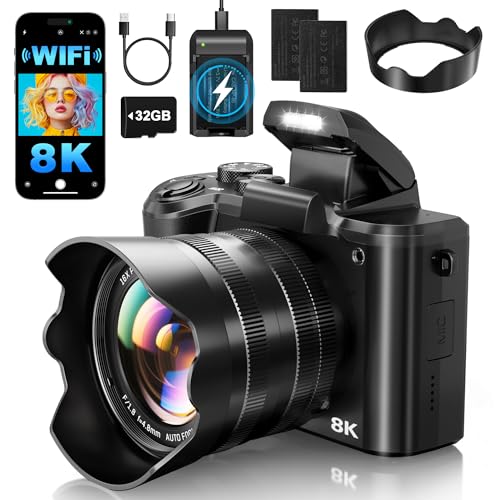
The K Digital Camera, boasting an impressive 88MP sensor and dual-lens system, is perfect for photographers enthusiastic to capture stunning architectural details. With 8K video resolution and fast autofocus, you’ll never miss a moment. The 3.2-inch IPS touch screen simplifies framing, while the 360° rotary dial offers quick mode switching for any scenario. Built-in WiFi lets you share your work instantly, and the 6-axis stabilization guarantees smooth video captures. It’s user-friendly, making it ideal for both beginners and seasoned pros. Plus, with two large-capacity batteries, you can shoot longer without interruptions. Your architectural photography just got an upgrade!
Best For: Photographers of all levels looking to enhance their skills and capture high-quality images and videos in various settings.
Pros:
- High 88MP sensor and 8K video resolution for exceptional image quality.
- User-friendly features like a touch screen and a 360° rotary dial for easy mode switching.
- Built-in WiFi for instant sharing and compatibility with social media platforms.
Cons:
- May be overwhelming for complete beginners due to advanced features.
- Dual-lens system might add to the camera’s bulk compared to single-lens models.
- Battery life, while extended with two batteries, could still be a concern during long shooting sessions.
Canon EOS R100 Mirrorless Camera with RF-S18-45mm Lens Kit

For aspiring architectural photographers seeking an affordable yet powerful option, the Canon EOS R100 Mirrorless Camera with RF-S18-45mm Lens Kit stands out. With its 24.1-megapixel APS-C sensor, you’ll capture stunning detail and clarity in your shots. The compact design makes it easy to carry, perfect for on-the-go shooting. Plus, the advanced Dual Pixel CMOS AF guarantees precise focus, even on intricate structures. You’ll appreciate the 4K video capabilities to showcase dynamic architectural visuals. Whether you’re shooting in natural light or low-light conditions, this camera delivers impressive performance without breaking the bank, making it an excellent choice for beginners.
Best For: Aspiring architectural photographers looking for an affordable and powerful camera to capture stunning details and clarity in their shots.
Pros:
- Exceptional 24.1-megapixel APS-C sensor for high image quality.
- Compact and lightweight design, making it portable for on-the-go shooting.
- Advanced Dual Pixel CMOS AF with face, eye, and animal detection for precise focusing.
Cons:
- Limited low-light performance compared to higher-end models.
- 4K video recording is at a lower frame rate (24 fps) than some competitors.
- The kit lens may not be suitable for more specialized photography needs.
Canon Point and Shoot Digital Camera (2956C001)

Architects and enthusiasts alike will appreciate the Canon Point and Shoot Digital Camera (2956C001) for its impressive 40x optical zoom, allowing you to capture intricate details of buildings from a distance. With a 20.3-megapixel CMOS sensor and DIGIC 8 image processor, your photos will showcase stunning clarity. The camera also offers 4K video capabilities and high-speed continuous shooting up to 7.4 fps, perfect for capturing dynamic architectural scenes. Plus, the 3.0-inch tilt-type LCD makes framing shots easy, while built-in Wi-Fi and Bluetooth technology enhances connectivity. This silver beauty is a versatile choice for any architectural photography enthusiast.
Best For: Architects and photography enthusiasts looking for a compact camera that delivers high-quality images and versatile shooting options.
Pros:
- 40x optical zoom allows for capturing intricate details from a distance.
- 4K video and time-lapse movie capabilities provide high-quality video options for dynamic scenes.
- Built-in Wi-Fi and Bluetooth technology enhances connectivity for easy sharing and remote control.
Cons:
- No optical viewfinder may limit shooting options in bright sunlight.
- Continuous shooting speed of 7.4 fps may not satisfy high-action photography needs.
- Tilt-type LCD screen might not be ideal for all shooting angles compared to fully articulating screens.
Canon PowerShot SX740 HS Digital Camera

If you’re seeking a compact yet powerful camera for architectural photography, the Canon PowerShot SX740 HS is an excellent choice. With its 20.3MP CMOS sensor and 40x optical zoom, you can capture stunning details from various distances. The DIGIC 8 image processor guarantees sharp, vibrant images, while its 4K UHD video capability offers cinematic quality. You’ll appreciate the 5-axis image stabilization for smooth videos, even in low light. Plus, with Wi-Fi and Bluetooth connectivity, sharing your work is a breeze. Weighing just 2.73 pounds, it’s portable enough to take anywhere your architectural adventures lead you.
Best For: Those seeking a compact camera with high zoom capability and 4K video for capturing architectural photography.
Pros:
- High-quality images with a 20.3MP sensor and DIGIC 8 image processor.
- Versatile 40x optical zoom allows for detailed shots from various distances.
- Compact and lightweight design makes it easy to carry for on-the-go photography.
Cons:
- Limited low-light performance compared to larger sensor cameras.
- 3-inch LCD display may not provide the best viewing experience in bright sunlight.
- No RAW image format support, limiting post-processing options for advanced users.
Canon EOS R100 Double Zoom Lens Kit
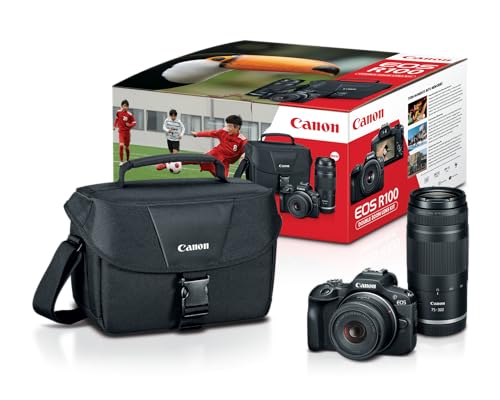
The Canon EOS R100 Double Zoom Lens Kit is an ideal choice for budding photographers seeking to capture architectural marvels with precision and versatility. With the RF75-300mm telephoto lens, you can zoom in on intricate details, while the RF-S 18-45mm lens provides a broader perspective for capturing entire structures. This kit is perfect for exploring both telephoto and wide-angle shots, enhancing your creative options. Plus, the included Shoulder Bag 200 ES guarantees your gear stays protected while you’re on the go. This kit makes it easy to elevate your architectural photography skills and showcase stunning images.
Best For: Budding photographers seeking versatility and quality in their architectural photography.
Pros:
- Versatile lens options: Includes both telephoto and wide-angle lenses for diverse shooting opportunities.
- Protective carrying case: The Shoulder Bag 200 ES ensures safe transport of your gear.
- User-friendly design: Ideal for beginners, making it easy to capture stunning images without extensive experience.
Cons:
- Limited low-light performance: The maximum aperture of the lenses may not perform well in dim lighting conditions.
- Heavy for extended use: The combined weight of the camera and lenses may be cumbersome during long shooting sessions.
- No advanced features: Lacks some high-end features found in more professional camera kits, which may limit growth for experienced photographers.
Canon EOS RP Full-Frame Mirrorless Camera with RF24-105mm Lens Kit

For photographers seeking to capture stunning architectural details, the Canon EOS RP Full-Frame Mirrorless Camera with RF24-105mm Lens Kit stands out due to its impressive 26.2 MP resolution and versatile zoom range. Weighing just 16 ounces, it’s lightweight and easy to handle, making it perfect for on-the-go shooting. The RF24-105mm lens offers optical image stabilization and a minimum focusing distance of 0.43 ft, ensuring sharp images even in challenging conditions. With a 4K video capture option, dual pixel autofocus, and built-in Wi-Fi and Bluetooth, this kit delivers everything you need to elevate your architectural photography.
Best For: Photographers looking for a lightweight, versatile camera system to capture high-quality architectural details and stunning imagery.
Pros:
- Excellent 26.2 MP resolution for detailed images.
- Compact and lightweight design at just 16 ounces, ideal for travel.
- Dual Pixel autofocus with 4779 AF points for fast and accurate focusing.
Cons:
- Limited continuous shooting speed of 5 fps may not suit fast-action photography.
- Maximum aperture range of F4-7.1 may restrict low-light performance.
- Single memory card slot may pose a risk for important shoots if card failure occurs.
Factors to Consider When Choosing a Camera for Architectural Photography
When you’re choosing a camera for architectural photography, several key factors come into play. You’ll want to contemplate sensor size for image quality, lens versatility for capturing different angles, and autofocus efficiency for sharp details. Additionally, features like image stabilization and low-light performance can make a significant difference in your results.
Sensor Size Importance
Choosing the right sensor size is essential in architectural photography, as it directly influences the quality of your images. Larger sensors, like full-frame ones, capture more light, leading to better detail and reduced noise, particularly in low-light conditions. They offer a wider field of view and greater depth of field control, making them perfect for expansive architectural scenes. On the other hand, APS-C sensors are smaller and often result in a crop factor, limiting your ability to capture large buildings effectively. Additionally, larger sensors provide a superior dynamic range, allowing you to manage highlights and shadows better. Finally, they often come with advanced autofocus systems that enhance your precision in capturing intricate architectural details.
Lens Versatility Options
As you immerse yourself in architectural photography, understanding lens versatility is essential for capturing the essence of structures. A range of lens options lets you explore different perspectives; wide-angle lenses can showcase expansive buildings, while telephoto lenses focus on intricate details. Tilt-shift lenses help correct perspective distortion, ensuring straight lines in tall structures.
Autofocus System Efficiency
An efficient autofocus system is essential for capturing the intricate details and lines of architectural photography. When you’re choosing a camera, look for advanced features like Dual Pixel CMOS AF, which enhances focusing speed and accuracy, especially in tricky lighting. A higher number of autofocus points—like 651 AF zones—will help you track subjects within complex architectural scenes, ensuring sharp focus. If you plan to include people in your shots, eye detection and subject tracking can add valuable context and scale. Additionally, Continuous-Servo AF mode is perfect for maintaining focus on moving subjects, which is often the case in bustling urban environments. Prioritizing these autofocus capabilities will elevate your architectural photography experience.
Image Stabilization Features
Image stabilization features play a pivotal role in architectural photography, helping you capture stunning details without the worry of blurriness from camera shake. When you’re shooting at slower shutter speeds or using telephoto lenses, it’s crucial to have reliable stabilization. Look for cameras with optical image stabilization (OIS), which compensates for small movements during handheld shooting. This guarantees clearer images of intricate architectural elements. Additionally, if you plan to capture video, consider cameras with electronic image stabilization (EIS) to further smooth out vibrations. Steady shooting at wide-angle settings helps maintain the integrity of straight lines, avoiding distortion. Advanced stabilization systems offer versatility for both stills and video, making them invaluable tools for any architectural photographer.
Low-Light Performance Capability
Low-light performance can make or break your architectural photography, especially when capturing the intricate details of interiors or the soft glow of exteriors at dusk. To excel in these conditions, look for a camera with a wide ISO range, ideally extending to 12800 or more. This flexibility helps you achieve clearer images without excessive noise. Advanced image stabilization features are also essential, as they minimize blurriness from camera shake during longer exposures. High-quality lenses with larger apertures, like f/2.8 or wider, allow more light to hit the sensor, enhancing your low-light capabilities. Finally, cameras with advanced autofocus systems, such as Dual Pixel CMOS AF, guarantee you maintain sharp focus on architectural elements, even when the light is challenging.
Connectivity and Sharing
How important is connectivity in today’s photography landscape? It’s essential, especially for architectural photography. Built-in Wi-Fi and Bluetooth allow you to transfer images and videos effortlessly to your smartphone, tablet, or computer, making sharing and editing a breeze. With dedicated camera apps, you can enhance your remote shooting, enabling live viewing from connected devices for better composition. NFC technology simplifies pairing your camera with mobile devices, speeding up your workflow for social media or cloud storage uploads. USB-C ports facilitate fast file transfers, letting you move large architectural images to editing software without delay. Plus, compatibility with cloud-based services gives you seamless backup solutions, so you can access your projects from anywhere.
Build Quality and Durability
When you’re choosing a camera for architectural photography, build quality and durability can’t be overlooked. A robust build and weather-sealing are essential, especially since you’ll often be shooting outdoors in varying conditions. Consider the weight and material of the camera body; these factors affect handling and stability, vital for capturing detailed shots of structures. A durable camera is less likely to get damaged during travel, ensuring it remains functional for long-term projects. Look for features like a sturdy tripod mount to enhance stability for long exposures, which are often necessary for intricate details. Finally, an ergonomic design with easy access to controls will let you work efficiently in diverse environments. Choose wisely for lasting performance!